

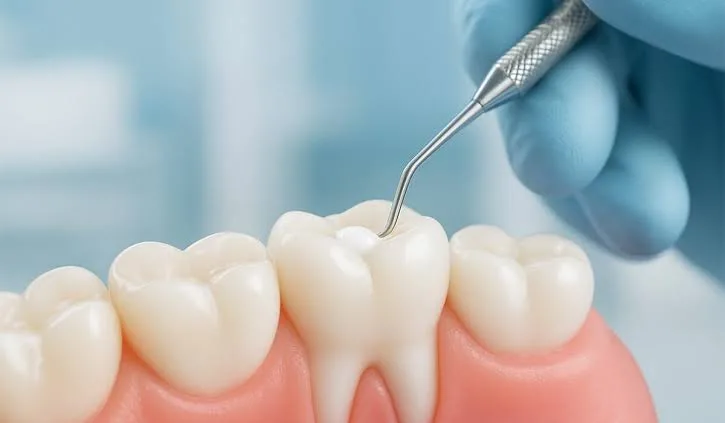
Tooth decay often progresses silently. First comes a slight twinge with cold water, then discomfort starts while eating. Many people looking for a Nilüfer dental filling ask the question, "Can this tooth be saved with a filling?" right at this point. In this article, we explain what a filling is, which materials are used, how the procedure progresses, and what should be considered afterward. Our aim is to reduce the questions in your mind before going for an examination.
What is a dental filling?
A dental filling is when a tooth that has lost substance due to decay, fracture, or wear is cleaned by the dentist and restored with a suitable material. In this way, the tooth regains its chewing function and the progression of decay deeper into the tooth is prevented.
Fillings are not done only for cavities. They may also be considered for cracked teeth, teeth with broken tips, or teeth worn down along the gum line. Which tooth will be filled and with which method is determined by the dentist after an oral examination and, if necessary, an X-ray.
In which cases is a filling needed?
The following signs may indicate the need for a filling:
A visible pit, stain, or cavity on the tooth
Persistent sensitivity to cold, hot, or sweet foods
A small piece breaking off the tooth or a crack forming
Old filling falling out or a gap forming at its edge
Wear and sensitivity along the gum line
None of these signs alone is enough for a diagnosis. Moreover, the absence of pain does not mean there is no decay. That is why it is important to attend checkups at intervals recommended by the dentist.
What are the materials used for dental fillings?
When you make an appointment for a Nilüfer dental filling, the dentist will most likely tell you about several material options. The most commonly used ones are:
Composite (resin) filling: This is a tooth-colored material and is hardened with light. Since it adheres to the tooth, it allows work with less tissue loss. It can be used on front and back teeth.
Glass ionomer filling: It has a fluoride-releasing structure. It is generally preferred for baby teeth and small losses at the neck of the tooth. It may not be as durable as composite in areas exposed to heavy chewing pressure.
Amalgam filling: This is a silver-colored material known for many years. Due to its color, it is not preferred in visible areas. Its use has been restricted in some groups because of its mercury content.
Ceramic inlay and onlay: For large tissue losses, they are prepared in a laboratory and are usually completed in two sessions.
Material selection is made according to the size of the cavity, the tooth’s position in the mouth, chewing force, and the person’s expectations. It would not be correct to say that a single material is suitable for everyone.
How is a dental filling done?
The procedure progresses in several stages:
Examination and X-ray: The dentist evaluates the location and depth of the cavity.
Numbing: If deemed necessary, local anesthesia is applied. For superficial cavities, anesthesia may not be needed.
Removing the decay: The damaged part of the tooth is removed, and healthy tissue is preserved as much as possible.
Placing the filling: The material is placed layer by layer. In composite fillings, each layer is hardened with a special light.
Bite check and polishing: The dentist checks how the teeth fit together, smooths the surface, and polishes it.
A simple filling is usually completed in a single session. The duration varies depending on the size of the cavity. If the cavity is very close to the nerve, root canal treatment may be necessary. This also becomes clear during the examination.
What should be considered after a filling?
After the procedure is finished, a few simple rules will make the recovery process more comfortable:
Do not eat until the numbness wears off. Otherwise, you may accidentally bite your cheek or tongue.
Avoid very hard and sticky foods in the first few days.
If the filling feels high when you bite, let the dentist know without delay. A small adjustment is usually enough.
Continue brushing twice a day and using dental floss.
Sensitivity to hot or cold may last for a few days. If the complaint persists or the pain increases, go for a checkup.
How long does a dental filling last?
It is not correct to give a definite period. The lifespan of a filling depends on the material, the size of the filling, oral care, tooth-grinding habits, and eating patterns. While some fillings remain problem-free for years, others may need replacement sooner. That is why it is necessary not to miss checkup appointments and to have the filling margins monitored regularly.
What should you consider before getting a dental filling in Nilüfer?
There are many oral and dental health centers and clinics in Nilüfer. When making a choice, keeping the following points in mind will make things easier:
The institution should be licensed by the Ministry of Health
The examination and procedure should be performed by a dentist
The options and possible risks should be explained to you clearly
Sterilization and hygiene rules should be observed
The treatment plan and fee should be shared clearly before treatment begins
Information you receive during the examination is far more decisive than posts or photos on social media. If you are unsure, it is also possible to get a second opinion.
Frequently asked questions
Does a dental filling hurt? Local anesthesia is used for most fillings, and the aim is to prevent pain during the procedure. There may be mild sensitivity after the procedure, but it usually goes away quickly.
What should I do if a filling falls out? If possible, keep the piece, keep the area clean, and see the dentist as soon as possible. Decay can progress rapidly in an exposed tooth.
Can teeth whitening be done after a filling? Whitening does not change the color of the filling. Therefore, the order of whitening first and filling later should be planned together with the dentist.
Can a filling be done during pregnancy? Be sure to inform the dentist about your pregnancy. The dentist will decide together with you on the timing of non-urgent procedures.
Conclusion
When done while the decay is still small, a dental filling is one of the simplest ways to protect the tooth. When going for an examination for a Nilüfer dental filling, noting your complaints, the medications you use, and your questions will make the consultation more efficient. Regular brushing, dental floss, and periodic checkups help fillings stay healthy for a long time.
This article has been prepared for general informational purposes. It does not replace diagnosis or treatment. Please consult a dentist for an individualized assessment.